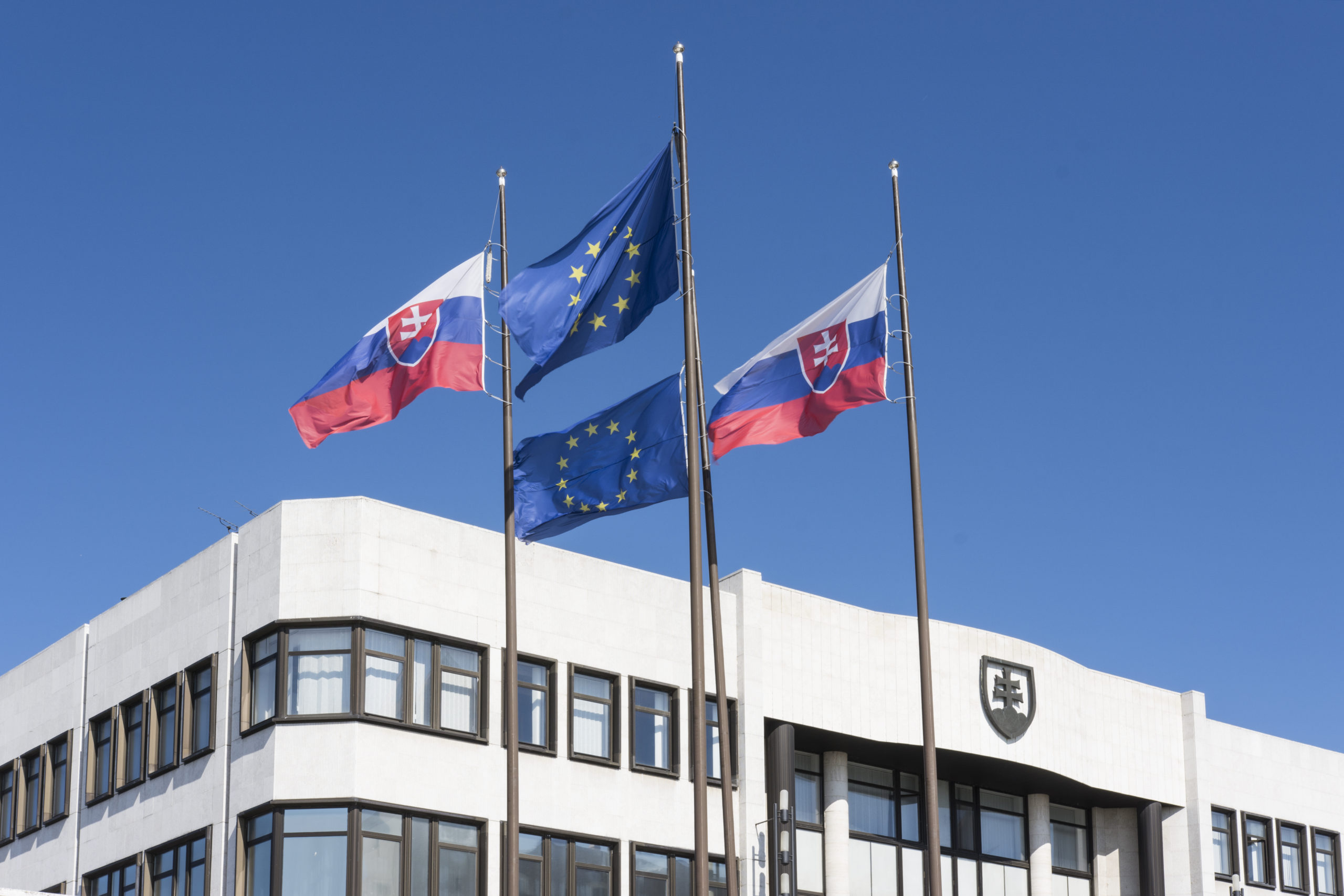
On June 2nd, 2026, the Slovak National Council passed an amendment to the Slovak Citizenship Act, which is bound to have an impact on Slovak citizenship-by-descent applicants. The bill introduces a few practical differences to the process, most notably removing residence permit requirement for citizenship-by-descent applicants. The change, which has garnered the most attention, is the addition of the formal requirement for a document evidencing a qualifying ancestor’s Czechoslovak citizenship.
Currently, all that remains is the president’s signature, which typically happens within around two weeks. Given that this governmental proposal has had smooth sailing until now, it is unlikely to face further scrutiny by the Slovak president.
Removal of the Residence Permit Requirement
The most significant change introduced by the bill will be the removal of the need for Slovak citizenship-by-descent applicants to acquire a residence permit in Slovakia. Currently, this requirement generally results in applicants applying for a residence permit together with the citizenship application, both being submitted at the same time. This will alleviate the administrative burden for both applicants and Slovak authorities, namely the immigration police.
In practice, the immigration police has extended discretionary residence permits to eligible applicants, which made it significantly easier to apply, as opposed to applicants having to first secure a residence permit through other means. At the same time, this informal procedure to obtain a residence permit presented a separate barrier to some applicants, whose evidence of their ancestor’s Czechoslovak citizenship was not clear enough for the immigration authorities. Furthermore, given its discretionary and informal nature, applicants generally only have “one shot” at applying for the residence permit, as the authorities are not required to ask applicants for further information if their application seems insufficient, nor is it possible to appeal a denial of this residence permit.
The upcoming changes will remove the residence permit process entirely and an applicant would be able to apply for citizenship without having to worry about getting a residence permit first. This will simplify and speed up the process for potential applicants.
Listina Certificate to Prove Citizenship
One of the most significant general changes brought forward by the bill will be the inclusion of the Listina certificate (given after an applicant’s citizenship oath) among documents, which are prima facie evidence of one Slovak citizenship. This is a long overdue change, as the fact that the Listina does not in-and-of-itself provide evidence of Slovak citizenship means that one must obtain the second citizenship certificate (osvedčenie) for any and all practical uses. This often causes newly minted Slovak citizens to wait up to half a year before they can obtain a Slovak passport or ID card, as the osvedčenie certificate is only issued in Slovakia.
The newly approved legislation introduces a 90-day window after the citizenship oath, during which the Listina acts as proof of citizenship and may be used to apply for Slovak vital registration, as well as a passport and/or ID card. It’s not clear why the government chose a 90-day window, as the osvedčenie certificate is valid for 6 months from issue and even this timeframe can prove insufficient for applicants to complete all the necessary steps to get a Slovak passport after taking their citizenship oath.
The legislator likely drew inspiration from the Czech Republic, where the Listina certificate has served as proof of citizenship since 2014. Nevertheless, both the Czech Listina and the osvedčenie certificates are valid for up to a year under Czech law.
Given the relatively short proposed validity window, it is possible that applicants going through Slovak embassies may still need to obtain an osvedčenie certificate to apply for a Slovak passport. Current scheduling and processing times make it challenging to take the oath, apply for and receive one’s Slovak birth and/or marriage certificate and make it to the passport appointment, all in the span of 3 months.
Furthermore, current practice shows that the Special Registrar takes longer to process vital records, where the applicant is not entered into the government’s population database. Currently, all citizenship-by-descent applicants (under Section 7(2)(j)) are entered into the database by the immigration authorities when being issued the residence permit. Once approvals are no longer conditional upon a residence permit, this administrative burden will shift entirely to the Special Registrar, which is likely to increase processing times.
Introduction of the Electronic Citizenship Certificate
Applications for the osvedčenie certificate submitted through the embassies will also undergo a new change, which will allow for more efficiency and faster processing. Starting from July 15th, all applications for the certificate will be sent to Slovakia electronically and the certificate itself will also be transmitted back to the embassy electronically, unless the applicant explicitly applies for a physical certificate.
Furthermore, the bill will allow applicants to submit applications for said certificate both electronically and through the mail. The exact practical implications of the electronic application remain to be seen and there’s no indication yet as to whether this will require access to Slovak e-government services, as well as whether simple scans of official documents would be considered sufficient. Generally, under Slovak law, physical documents require a trusted authority to certify the scans for admissibility in legal proceedings.
Formalization of Proof of Czechoslovak Citizenship for the Qualifying Ancestor
One of the most discussed provisions has been the addition of an explicit/formalized requirement for “certificate or document through which the applicant gives evidence that their [qualifying ancestor] was a Czechoslovak citizen born on the territory of the Slovak Republic…”.
While this provision may seem to introduce a new formal requirement, it is simply the formalization of an assumption implied by the amendment as enacted in 2022. It has always been up to the applicant to demonstrate that they fulfill the requirements of the Citizenship Act to be granted citizenship and thus to demonstrate each of the elements required by Section 7(2)(j) – namely that they have (1) an ancestor within the qualifying generations, who (2) was a Czechoslovak citizen (3) born in what is now Slovakia. Each element requires proof regardless of whether this is explicitly listed in the act. As with proof of citizenship prior to this amendment, there is no explicit provision in the Citizenship Act requiring birth certificates to account for one’s lineage to their qualifying ancestor. Nevertheless, one can hardly submit an application claiming lineage without proof of this lineage.
Furthermore, the new provision does not exhaustively list explicit formal documents by name to establish an ancestor’s Czechoslovak citizenship. This therefore does not significantly affect evidentiary rules under the act nor does it limit the type of (documentary) evidence available to prove one’s Czechoslovak citizenship.
One important distinction, which often goes unnoticed, is that whether someone held Czechoslovak citizenship is a question of law, rather than fact. As such, to determine one’s citizenship, the authorities must always consider all available facts and make a legal determination by applying the law valid at the time to the known facts. While some documents can be more helpful than others (especially those that establish a presumption of one’s citizenship, such a citizenship certificate or a passport), questions of law always remain subject to careful legal analysis that takes into account all available facts. Given that this is a preliminary question within the proceedings, the authorities must make a clear and well-reasoned determination, where no discretion may apply,[1] subject to possible scrutiny by the courts.
Hence, the author of this article believes that little will change when it comes to proving a qualifying ancestor’s Czechoslovak citizenship.
What Happens to On-going Cases?
The bill lacks specific transitional provisions that would clarify whether applications submitted before July 15th benefit from the recently approved changes as far as the removal of the residence permit. Generally, in the absence of such provisions, old applications are considered “grandfathered” under the old rules and the residence permit requirement would remain in place for those applicants until approval. Nevertheless, the author of this article believes it to be legally permissible for the Interior Ministry to approve citizenship applications after July 15th, even where the applicant has submitted their application prior to this date and lacks a residence permit.
This is unlikely to violate the ban on ex post facto legislation as it is to the benefit of the applicant and thus does not violate their legitimate expectations. Furthermore, applications are not formally submitted pursuant to a certain provision (exemption) of the law (even if this is indicated on the application) and the Ministry may approve the application, as long as at least one of the exemptions in the Citizenship Act applies. This further conforms to the principle of procedural economy, as it would prevent a denial followed by a new (likely successful) application submitted after July 15th.
Given the legal uncertainty, it is nevertheless still advisable to submit both a citizenship application, as well as a residence permit application if applying before July 15th. At the same time, the author of this article believes that the law does not prevent the Ministry from applying the new legislation to all cases after July 15th, regardless of when they were submitted.
Conclusion
The newly approved amendment will bring about a fair number of welcome changes for Slovak citizenship-by-descent applicants and will considerably speed up and simplify the process. Removing the residence permit requirement will alleviate the burden and uncertainty for many applicants, as well as free up resources at the immigration police, which is dealing with increased workload. Furthermore, procedural changes related to processes after one’s citizenship oath will likely speed up getting to a Slovak passport and further reduce redundant bureaucracy. All of the above will likely to a faster, more-streamlined process for all of the stakeholders involved.
[1] See Judgment of the Slovak Supreme Court dated 23 November 2016, case no. 2Sžo/99/2014